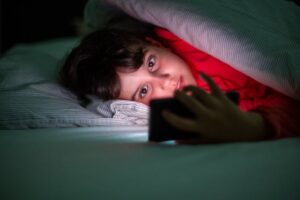
In today’s digital age, it’s almost impossible to avoid screens. When the house is quiet and your child is finally asleep, you might be scrolling through your phone. But have you ever wondered whether your phone screen light could be affecting your child’s sleep, or even their growth and development? Many parents worry that exposure to phone screens at night could reduce sleep quality, stunt growth, or even trigger early puberty. Let’s take a closer look at the science behind these concerns and find out what you can do to protect your child’s sleep.
How Phone Screen Light Can Affect Children’s Sleep
Children’s sleep quality depends largely on melatonin, a hormone secreted by the pineal gland in the brain. Melatonin helps regulate the biological clock and promotes deep, restorative sleep. However, exposure to bright light at night, especially light containing blue wavelengths, can suppress melatonin production. This can make it harder for children to fall asleep, stay asleep, or achieve deep sleep.
Studies show that even low-intensity light (above 5 lux) can disrupt melatonin secretion, and blue light—which is abundant in phone screens—has a stronger effect. Children are more sensitive to blue light than adults because their lenses allow more light to reach the retina.
So, while phone screens are not as bright as sunlight or overhead lights, prolonged exposure during evening hours can potentially delay sleep onset and reduce sleep quality.
Signs That Phone Screen Light Is Affecting Your Child’s Sleep
Parents may notice several subtle signs if screen light is interfering with their child’s sleep:
- Difficulty falling asleep even when the child is tired
- Restless sleep or frequent night waking
- Irritability or mood swings the following day
- Reduced attention span or hyperactivity in the morning
These signs are often temporary but can become chronic if exposure to screen light continues nightly.
Practical Ways to Minimize the Impact of Phone Screen Light
Fortunately, there are several simple strategies parents can use to reduce the impact of phone light on children’s sleep:
- Lower Screen Brightness
Reduce the brightness of your phone and keep it as far away from your child as possible. Even small changes can make a difference in melatonin production. - Use Eye Protection or Night Mode
Many phones offer “night mode” or “eye comfort mode” that shifts screen colors to warmer tones. Warmer light emits less blue light, reducing its impact on sleep. - Avoid Direct Exposure
Try to position your phone so that the light does not shine directly on your child’s face. Using your phone with your back to your child can help. - Limit Screen Time Before Bed
Encourage children to stop using screens at least 1–2 hours before bedtime. Replace phone or tablet time with quiet activities such as reading, drawing, or storytelling. - Create a Screen-Free Sleep Environment
Keep the bedroom dark and free from unnecessary lights, including digital clocks or night lights with blue tones.
Does Phone Screen Light Affect Growth or Puberty?
There are rumors suggesting that screen light may stunt growth or trigger early puberty by reducing melatonin production, which could in theory influence growth hormone secretion or sexual development. But what does the science actually say?
Growth Hormone and Sleep
Growth hormone is mainly secreted during deep sleep, and melatonin helps create favorable conditions for deep sleep. While in theory, lower melatonin could interfere with growth hormone secretion, current research has not proven that phone screen light has a measurable impact on children’s growth.
Early Puberty Concerns
Melatonin also has a role in regulating the release of gonadotropin-releasing hormone (GnRH), which controls sexual development. In theory, reduced melatonin could accelerate puberty. However, most research on this is based on animal studies, and no human studies have conclusively confirmed that evening phone light exposure triggers early puberty.
Bottom line: brief exposure to phone screens is unlikely to harm growth or trigger early puberty, though limiting screen time before bed is still a good practice.
How Phone Use Before Bed Affects Adults
It’s not just children who are affected by phone screen light. Adults can experience:
- Eye strain and fatigue: Using a phone in dim lighting can cause dry eyes, eye strain, or even retinal discomfort over time.
- Reduced sleep quality: Blue light suppresses melatonin in adults as well, making it harder to fall asleep or stay asleep.
- Mental overstimulation: Watching short videos or browsing social media late at night can overstimulate the brain, leading to restless sleep or difficulty reaching deep sleep stages.
Adults who model good screen habits help children learn healthy behaviors and improve the overall sleep environment at home.
Tips for Healthy Nighttime Phone Use
To minimize the impact of phones on your family’s sleep, try the following:
- Keep phones out of the bedroom when possible
- If phone use is necessary, use warmer screen colors and low brightness
- Avoid scrolling through social media or videos right before bed
- Encourage relaxing pre-sleep routines, such as reading or quiet conversation
- Ensure bedtime lighting is soft and indirect, creating a calm environment
Additional Strategies for Children’s Sleep
Besides minimizing phone light exposure, other habits can help promote better sleep:
- Maintain consistent bedtime routines
- Encourage daily outdoor activity, which helps regulate circadian rhythms
- Limit caffeine (including chocolate) in the afternoon and evening
- Use blackout curtains to eliminate streetlight exposure
- Keep bedrooms cool and quiet for optimal sleep conditions
By combining these habits with careful phone usage, parents can maximize sleep quality for their children.
Key Takeaways
- Phone screen light does affect children’s sleep, especially blue light emitted in the evening, but not as severely as some rumors suggest.
- Parents can reduce the impact by lowering screen brightness, enabling night mode, and avoiding direct exposure.
- There is no strong evidence that phone screen light stunts growth or triggers early puberty.
- Adults should also be mindful of screen use before bedtime, as it affects eye health, sleep quality, and mental restfulness.
- Creating a screen-free, calming sleep environment is the most effective way to protect your child’s sleep quality.
References
- Lee SI et al., Physiol Rep, 2018.
- Gooley JJ et al., J Clin Endocrinol Metab, 2011.
- Bonmati-Carrion MA et al., Int J Mol Sci, 2014.
- Cho Y et al., Chronobiol Int, 2015.
- Moyano DB et al., Energies, 2020.
- Hartstein LE et al., J Biol Rhythms, 2023.