Myopia is also called nearsightedness. It means a child can see things clearly up close, but far-away objects look blurry. For example, they may see a book clearly but struggle to read the board at school.
Myopia happens when the eyeball grows too long from front to back. When that happens, light focuses in front of the retina instead of directly on it. This makes distant vision blurry.
Once a child becomes myopic, it usually cannot be reversed. Glasses or contact lenses can correct vision, but they do not cure it. That is why prevention is so important.
Does Watching TV Directly Cause Myopia?
The simple answer is no. TV alone does not directly cause myopia.
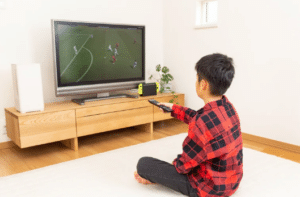
Watching TV from a normal distance does not usually strain the eyes in a harmful way. In fact, compared to phones or tablets, TV is often watched from several feet away. That distance matters.
The real problem is not the TV itself. The real problem is long hours of close-up work and not enough outdoor time.
Experts from the American Academy of Ophthalmology explain that near work and limited outdoor exposure are key risk factors for myopia. TV is usually not considered “near work” if the child sits at a proper distance.
So if your child watches TV from across the room for a short time each day, it is unlikely to be the main cause of myopia.
Why Are So Many Kids Becoming Nearsighted?
This is the bigger issue.
Around the world, myopia rates are rising. In some parts of Asia, more than half of teenagers are nearsighted. This is not because children suddenly started watching TV. TV has existed for many decades.
What has changed?
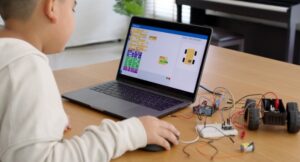
Children now spend more time indoors. They spend more time on close-up activities like reading, homework, phones, and tablets. Outdoor play time has decreased.
Research shows that outdoor light helps protect the eyes. Bright natural light triggers the release of dopamine in the retina. This helps control eye growth. When kids stay indoors all day, they miss this protective effect.
The World Health Organization has warned that increasing screen use and less outdoor activity may contribute to rising myopia rates.
So it is not just TV. It is a lifestyle pattern.
Is TV Better Than Tablets for Eyes?
When we compare devices, distance is very important.
TV is usually viewed from six to ten feet away. Tablets and phones are often held only eight to twelve inches from the face. That means the eyes must focus much harder for longer periods.
Close focusing for hours may increase the risk of eye strain and possibly myopia progression.
This is why tablets and smartphones are often more concerning than TV. The smaller the screen and the closer it is to the eyes, the more strain it creates.
So if you are choosing between a large TV across the room and a tablet in your child’s hands, TV is usually less stressful for the eyes.
Does Sitting Too Close to the TV Cause Myopia?
Many parents remember hearing this growing up. “Don’t sit too close to the TV or you will ruin your eyes!”
In reality, sitting very close to the TV does not directly cause permanent damage. But children who already have myopia often sit closer because they cannot see clearly from far away.
So sometimes sitting close is a sign of myopia, not the cause of it.
However, sitting too close can cause temporary eye strain or headaches. It is still better to encourage proper distance.
A simple rule is this: the distance from the TV should be at least five times the width of the screen.
How Much Screen Time Is Too Much?
The American Academy of Pediatrics recommends limiting screen time for young children. For children ages 2 to 5, about one hour per day of high-quality content is suggested.
But when it comes to eye health, the bigger focus should be balance.
Ask yourself these questions:
How many hours does my child spend looking at close screens each day?
How much time does my child spend outdoors?
Does my child take breaks while reading or using devices?
Too much close-up work without breaks increases eye fatigue.
A helpful habit is the 20-20-20 rule. Every 20 minutes, look at something 20 feet away for at least 20 seconds. This relaxes the focusing muscles.
Can Outdoor Play Really Protect Vision?
Yes, outdoor time is one of the strongest protective factors against myopia.
Studies show that children who spend at least 1 to 2 hours outside daily have a lower risk of developing myopia.
Outdoor light is brighter than indoor light, even on cloudy days. This bright light helps regulate eye growth. It does not mean children must stare at the sun. Just normal outdoor play is enough.
Running, biking, walking the dog, or playing sports all count.
So if you want to protect your child’s vision, outdoor play may be more important than cutting TV completely.
What Are the Real Risk Factors for Myopia?
Here are the main ones:
Family history of myopia
Long hours of close-up reading or screen use
Little outdoor time
Early start of heavy academic work
TV alone is not at the top of this list.
If both parents are nearsighted, the child has a higher risk. In that case, regular eye exams are especially important.
Should Parents Ban TV to Prevent Myopia?
Banning TV alone will not stop myopia.
If a child stops watching TV but replaces it with hours of tablet use or reading indoors, the risk may not change.
Instead of banning, focus on balance.
Encourage outdoor time every day.
Limit long periods of close-up screen use.
Make sure screens are used at a safe distance.
Schedule regular eye checkups.
Healthy habits matter more than fear.

Yogo Vision Blue Light Blocking Glasses for Kids UV Protection Girls Boys Blue Light Glasses Anti Eyestrain
Final Thoughts for Worried Parents
It is normal to worry. Myopia is increasing, and it can feel scary.
But TV is not the main villain. Long close-up screen use and lack of outdoor play are bigger factors.
You do not need to panic if your child watches some TV. Focus on balance. Focus on outdoor time. Focus on healthy routines.
Small daily habits make a big difference over time.
FAQ Section
Q1: Does watching TV cause myopia in children?
A1: No. Watching TV from a normal distance does not directly cause myopia. Long close-up screen use and little outdoor time are bigger risk factors.
Q2: Is sitting too close to the TV bad for eyes?
A2: Sitting close does not permanently damage the eyes. It may cause eye strain. Children with myopia often sit close because they cannot see clearly from far away.
Q3: Are tablets worse than TV for myopia?
A3: Tablets are usually held much closer to the eyes, which increases eye strain. Long close-up use may raise the risk more than watching TV from a distance.
Q4: How much outdoor time helps prevent myopia?
A4: Experts suggest at least 1 to 2 hours of outdoor play daily. Bright natural light helps protect healthy eye growth.
Q5: Can myopia be reversed once it starts?
A5: Myopia usually cannot be reversed. Glasses or contact lenses correct vision, but they do not cure the condition.