Why do kids refuse to brush their teeth?
This is one of those everyday struggles that shows up in many homes. It can feel confusing. One night goes fine, the next night turns into a small battle. Same toothbrush, same bathroom, completely different reaction.
Most of the time, kids are not refusing just to be difficult. There is usually a reason under the surface. Sometimes it is about control. Sometimes it is discomfort. And sometimes it is simply that brushing feels boring compared to everything else they would rather be doing.
Understanding the “why” makes everything easier. Without that, it turns into guesswork, and guesswork often leads to frustration on both sides.
Is it normal for toddlers to hate brushing their teeth?
Yes, very normal.
Toddlers are at a stage where they want independence, but they do not yet have the skills to manage everything on their own. Brushing teeth sits right in the middle of that tension. They want to do it themselves, but they cannot do it well yet.
So what happens? They resist help. Or they rush through it. Or they simply refuse.
It is also a sensory experience. The taste of toothpaste, the feeling of bristles, the sound of brushing. For some kids, it feels strange or even uncomfortable. That alone can be enough to trigger resistance.
Parents often think something is wrong. In most cases, it is just part of development.
Kids want control, even during small routines
This part is easy to overlook.
Brushing teeth may seem like a simple task to an adult, but to a child, it can feel like something being “done to them.” Especially if they are told when, how, and how long without any choice.
Children naturally push back when they feel they have no control. It is not about the toothbrush itself. It is about having a say.
Small choices can make a difference. Which toothbrush to use. Which song to play. Which flavor of toothpaste. These details seem minor, but they give children a sense of ownership.
When kids feel involved, resistance often softens.
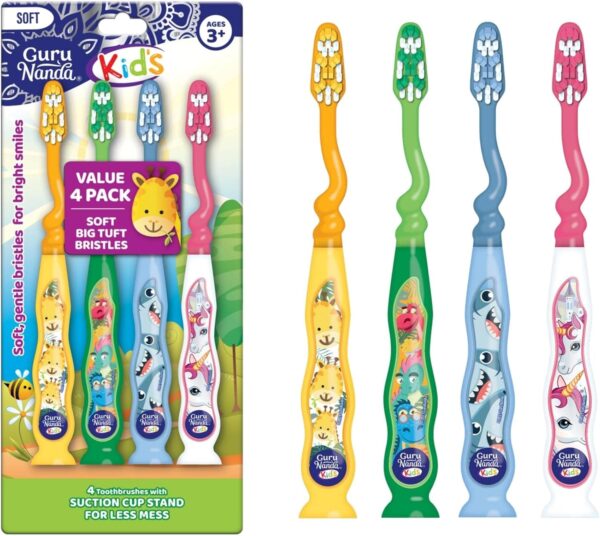
GuruNanda Kids Toothbrush with Suction Cup & Fun Animal Designs
Brushing teeth can feel uncomfortable or even unpleasant
Not every child experiences brushing the same way.
Some children are more sensitive to touch. The feeling of bristles on gums can feel too strong. Others dislike certain toothpaste flavors, especially strong mint.
It is worth noting that discomfort does not always show clearly. A child may not say “this hurts” or “this feels strange.” Instead, they simply refuse.
Trying a softer toothbrush or a milder toothpaste can help. Sometimes the issue is not behavior at all. It is sensory.
Kids get distracted easily, especially at bedtime
Evenings are tricky.
By the time brushing comes around, kids are often tired. Their attention is already fading. Brushing teeth is not the most exciting activity, so it becomes easy to resist or rush.
Add in distractions like toys, screens, or siblings, and focus disappears quickly.
This is why routine matters so much. When brushing happens at the same time, in the same order, every day, it becomes predictable. Less thinking, less arguing.
Pairing brushing with something familiar, like bedtime stories, can help anchor it in the routine.
Sometimes kids simply do not understand why brushing matters
To a child, brushing teeth does not feel urgent.
They do not see cavities forming. They do not think about long term dental health. All they know is that brushing takes time away from play or rest.
That gap in understanding can lead to resistance.
Simple explanations work better than long lectures. Talking about “sugar bugs” or “keeping teeth strong” makes more sense to them than abstract health ideas.
According to Centers for Disease Control and Prevention, building early dental habits helps prevent cavities, but children need that message in a way they can relate to.
Power struggles can make brushing worse over time
This is where things often get stuck.
If brushing turns into a daily argument, kids begin to associate it with stress. Even before the toothbrush appears, resistance starts building.
Parents may push harder. Kids push back more. It becomes a loop.
Breaking that pattern takes a shift in approach. Less pressure, more cooperation. It may feel slower at first, but it usually leads to better results over time.
Sometimes stepping back slightly can actually move things forward.
How to make kids more willing to brush their teeth
There is no single trick that works for every child. But certain strategies tend to help in most cases.
- Keep a consistent routine every day
- Let kids make small choices
- Use music or a timer for structure
- Stay calm, even when kids resist
Consistency matters more than perfection. Even if brushing is not perfect every night, keeping the habit going is what builds long term success.
The American Dental Association recommends brushing for two minutes, but getting there can take time. It is okay to build up gradually.
When should parents step in and help?
Children often want to brush on their own, but most are not able to clean their teeth properly until around age seven or eight.
That means parents still need to be involved, even if the child insists on independence.
A helpful approach is letting the child start, then the parent finishes. This keeps the child engaged while making sure teeth are actually clean.
It can feel repetitive. Some nights go smoothly, others do not. That is part of the process.
What if a child still refuses to brush teeth?
Some days will be harder than others. That is normal.
If refusal continues, it helps to look at the bigger picture. Is the child tired? Is the routine inconsistent? Is there discomfort that has not been noticed yet?
Sometimes small adjustments make a big difference. Changing the timing. Switching toothbrush types. Adding a fun element.
Other times, it simply takes patience. Habits do not form overnight.
Health experts, including those referenced by World Health Organization, often highlight that consistent daily habits play a key role in long term health. That includes oral care.
A small shift in mindset can change everything
Brushing teeth is not just about cleaning teeth.
It is about building a habit that lasts for years. That habit starts with small, sometimes messy steps. Resistance, hesitation, even refusal. All of it is part of the learning process.
Instead of asking “why is this so hard,” it sometimes helps to ask “what is my child trying to tell me here?”
The answer is not always obvious. But once it becomes clearer, brushing usually gets easier.
FAQ
1. Why does my toddler refuse to brush their teeth?
Toddlers often resist brushing because they want control, feel uncomfortable, or do not understand why it matters.
2. How can I get my child to brush their teeth without a fight?
Keep routines consistent, offer small choices, and use fun tools like songs or timers to make brushing easier.
3. Is it normal for kids to hate brushing teeth?
Yes, it is common. Many children go through phases of resisting brushing, especially at younger ages.
4. At what age should kids brush teeth on their own?
Most children can brush effectively on their own around age seven or eight, but supervision is still important before that.
5. What if my child refuses to brush every night?
Look for patterns like tiredness or discomfort. Adjust routines and stay patient. Consistency usually improves cooperation over time.