When can kids really brush their teeth alone?
This is one of those questions almost every parent asks at some point. And the honest answer is not a single age.
Most children start trying to brush their teeth alone around age 3 or 4. That is the “I can do it myself” stage. But being able to brush and actually doing it properly are two very different things.
In most cases, kids only start brushing effectively on their own around age 7 or 8. Even then, some supervision is still needed. Teeth cleaning is not just about movement. It is about reaching every corner, using enough time, and not missing spots.
So the real answer is a range, not a fixed number.
Why age 3 to 5 is not the “independent brushing” stage
At this age, children are still building basic coordination. Holding a toothbrush feels fun, but not always controlled.
They may brush for a few seconds and feel done. Or focus only on one area of the mouth. Sometimes they chew the toothbrush more than they brush with it.
It is completely normal.
This stage is more about learning than doing it right. Kids are building familiarity. They are watching parents. They are getting used to the routine.
The American Academy of Pediatrics often highlights that early childhood habits are formed through repetition and modeling, not perfection. That applies strongly to brushing teeth.
So in this stage, parents still need to take the lead. Let the child participate, but not fully manage the process.
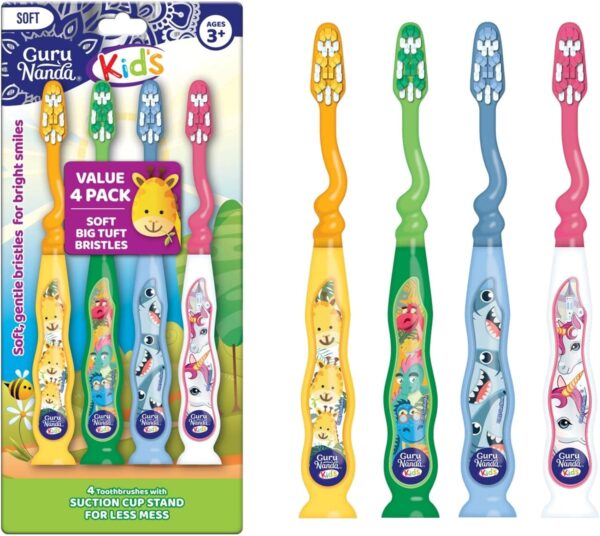
GuruNanda Kids Toothbrush with Suction Cup & Fun Animal Designs - Soft Bristles for Healthy Gums
Why age 6 is a turning point for brushing independence
Around age 6, something starts to shift.
Hand control improves. Attention span gets longer. Kids begin to understand steps in a routine instead of just rushing through them.
At this stage, children often want more independence. They may say, “I can do it myself now.” And they mean it.
But here is the catch. Even though they want independence, their brushing skills are still developing. They often miss back teeth or rush through the process.
This is why age 6 is more like a training phase than full independence.
A good approach is simple:
Let the child brush first, then the parent checks or finishes the job.
It is not about taking control away. It is about guiding until the skill becomes stable.
Why most kids are not fully independent until age 7 to 8
By age 7 or 8, most children have better coordination and more awareness of their own body. They can follow steps more carefully and understand instructions like “brush for two minutes” or “don’t forget the back teeth.”
This is usually the stage where independent brushing becomes realistic.
Still, even at this age, occasional supervision helps. Not because kids cannot do it, but because they sometimes rush. Especially when they are tired or distracted.
Think of it like riding a bike. They can do it, but occasional guidance keeps things on track.
What actually affects when a child can brush alone
Age is only part of the picture. There are a few other factors that matter just as much.
One big factor is hand coordination. Some kids develop fine motor skills earlier, others later.
Another factor is routine consistency. Kids who brush regularly with parents tend to learn faster.
Focus and patience also matter. Brushing teeth requires slowing down, even when the child wants to move on quickly.
And finally, motivation plays a role. If brushing feels like a fight every night, progress slows down. If it feels normal and predictable, kids learn faster.
What parents often get wrong about brushing independence
One common misunderstanding is thinking independence means “no more help.”
That is not how dental habits work.
Even adults sometimes miss spots when brushing. So expecting a 6 year old to be perfect alone is not realistic.
Another misunderstanding is rushing the process. Some parents try to switch to full independence too early, hoping it will reduce stress. But it often creates more problems later, like uneven cleaning habits or resistance.
The goal is not speed. The goal is long term habit building.
How to teach kids to brush independently step by step
Independence does not happen overnight. It develops in stages.
A simple progression often looks like this:
- Age 3 to 5: parent brushes, child participates
- Age 5 to 6: child starts brushing with supervision
- Age 6 to 7: child brushes first, parent checks
- Age 7 to 8: mostly independent brushing with reminders
This is not a strict rule, but a common pattern seen in many families.
The key is gradual release of responsibility, not sudden change.
Why supervision still matters even after kids brush alone
Even when kids can brush independently, supervision does not completely disappear.
It becomes lighter, not absent.
Parents might not brush for the child anymore, but they still check technique, remind timing, or observe routine consistency.
The Centers for Disease Control and Prevention notes that consistent oral hygiene habits in childhood help prevent cavities and long term dental issues. That consistency is easier to maintain with occasional parental guidance.
In real life, kids often brush faster than they should. A quick reminder can make a big difference.
What if a child refuses to brush properly alone?
This happens more often than people expect.
Sometimes kids enjoy independence but skip steps. Other times they resist because brushing feels boring or tiring.
In these cases, going back one step is normal. There is no harm in temporarily returning to shared brushing.
It is not a setback. It is adjustment.
Children are not linear learners. Some weeks they improve quickly. Other weeks they slow down. That is just part of development.
Simple signs a child is ready to brush alone
Instead of focusing only on age, there are clearer signs of readiness:
- Can hold and control a toothbrush properly
- Brushes for close to two minutes without stopping early
- Reaches all areas of the mouth consistently
- Follows simple instructions without reminders
- Shows interest in doing it independently
If most of these are present, independence is likely close.
Still, occasional checking helps maintain quality.
Why brushing independence is more about habit than age
It is easy to think of brushing as a skill milestone. But it is really a habit milestone.
Children are not just learning how to brush. They are learning that brushing happens every day, no matter what.
That is why consistency matters more than timing. A child who starts later but has a strong routine often does better than a child who starts early but lacks structure.
The habit is what stays for life, not the exact age it started.
FAQ
1. At what age should kids brush their teeth alone?
Most kids start brushing alone around age 6, but full independence usually happens closer to age 7 or 8.
2. Should parents still supervise brushing at age 7?
Yes, occasional supervision is still helpful to make sure all areas are cleaned properly.
3. What if my child wants to brush alone earlier?
It is fine to let them try, but parents should still check or finish the brushing.
4. Why do kids miss spots when brushing alone?
Because hand coordination and focus are still developing. It is very normal at younger ages.
5. How can I help my child brush independently?
Use gradual steps, consistent routines, and let them practice while still receiving guidance.