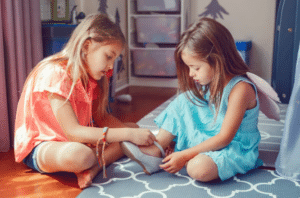
Children hear the word "no" quite often. No hitting, no grabbing toys, no running into the street, and no interrupting someone who is speaking. But there is another side to learning limits that deserves just as much attention: children need to understand their own boundaries and respect the boundaries of other people.
So, what is a boundary for kids? A boundary is a limit that helps a child understand what feels safe, acceptable, and comfortable, as well as what is not okay. Boundaries can involve a child's body, personal space, feelings, belongings, time, and relationships. For example, a child might say, "Please don't touch my hair," or "I need some quiet time." Another child might explain, "I don't like being called that name." These are simple ways to express personal limits.
Healthy boundaries are not about making children selfish, overly sensitive, or difficult to deal with. They help children understand that everyone has needs and feelings that deserve respect. Children also need to understand that having a boundary does not mean getting everything they want. A child can ask a sibling not to touch a favorite toy, but the family may still have rules about sharing common items. The goal is to help children speak up, listen to others, and handle disagreements without hurting anyone.
What Does a Boundary Mean for Kids?
A boundary is a line that helps define what is okay and what is not okay for a person. Some boundaries are easy to see, such as a classroom rule about keeping hands to oneself. Others are less obvious. A child might feel uncomfortable when a friend keeps asking personal questions, when a relative insists on a hug, or when a classmate reads a private note without permission. These situations show why children need more than a list of rules. They need to understand personal comfort, consent, and respect.
Boundaries can be physical, emotional, social, or related to personal belongings and responsibilities. A physical boundary might mean asking someone to step back. An emotional boundary might mean saying, "Please don't make fun of me when I'm upset." A boundary around belongings might mean asking a sibling to get permission before borrowing a game. A time boundary might mean telling a friend that playtime is over because homework needs to be finished.
Children will not always recognize or explain their boundaries perfectly. A preschooler might push another child away because they do not yet know how to say, "I need more space." An older child might become quiet rather than tell a friend that a joke feels hurtful. These reactions are opportunities for adults to teach useful words and skills. Instead of focusing only on whether the child behaved correctly, it helps to ask what happened, what the child was feeling, and how the situation could be handled next time.
COMOMY Playpens for Babies and Toddlers, 71"x59" Baby Playard Extra Large
Why Are Healthy Boundaries Important for Children?
Healthy boundaries help children feel safer in everyday life. When children know that they can speak up about discomfort, ask for privacy, or tell a trusted adult about a problem, they have more ways to protect themselves. This does not mean children can always prevent harmful situations. Adults remain responsible for providing safety and stepping in when necessary. Still, knowing how to express a concern can help a child seek support sooner.
Boundaries also support emotional development. Children gradually learn that they can feel angry without hitting, feel disappointed without insulting someone, and disagree without ending a friendship. They begin to understand that feelings are real and important, but feelings do not give anyone permission to hurt another person. This distinction is a major part of growing up. It helps children manage strong emotions while treating other people fairly.
There is also a social benefit. Children who understand boundaries are better prepared to notice when a friend wants to stop playing, when a classmate does not want to be teased, or when someone needs time alone. They can learn to say no without being cruel and hear no without assuming they are disliked. These skills take practice, and children will make mistakes. What matters is helping them repair problems, take responsibility, and build relationships based on mutual respect rather than pressure or fear.
1. Physical Boundaries: Respecting the Body and Personal Space
Physical boundaries are about a person's body and the space around it. Children need to know that their bodies deserve care and respect. This includes understanding that nobody should hit, kick, push, or touch them in a way that makes them uncomfortable. They should also learn that other people have the same right to physical space. Even a playful action can become a problem when someone asks for it to stop.
A simple example is a child who enjoys rough play until it becomes too much. If the child says, "Stop, that's too hard," the other child should stop. The same rule applies to tickling, chasing, wrestling, and games involving physical contact. A child who laughs during tickling may still want it to end. Laughter does not always mean someone is comfortable, so the clearest approach is to stop when asked and check whether the other person wants to continue.
Body boundaries also include personal care and privacy. Children can be taught the correct names for body parts, that private parts deserve special protection, and that they can tell a trusted adult if a touch or request makes them uncomfortable. Necessary care, such as help with bathing or a medical examination, should be explained in an age-appropriate way and handled with respect for the child's privacy. Children should never be told to keep an uncomfortable touch secret. If something feels wrong, they should know they can speak up, even if the person involved is someone they know.
2. Emotional Boundaries: Protecting Feelings Without Hiding Them
Emotional boundaries help children understand which feelings belong to them and how to respond to other people's feelings. For example, a child can care about a friend's disappointment without agreeing to do something that feels wrong. A child can listen when a sibling is angry without accepting insults or threats. These boundaries teach an important lesson: kindness does not require saying yes to everything.
Children sometimes feel responsible for keeping everyone happy. They may agree to share something they want to keep, join a game they dislike, or hide their own sadness because a friend might get upset. It is helpful to remind them that other people's feelings matter, but they are not responsible for fixing every feeling someone else has. They can be kind and still say, "I don't want to do that," or "I need a break."
Adults should also model emotional boundaries. If a parent is frustrated, it is reasonable to say, "I'm upset right now, so I'm going to take a few minutes to calm down before we talk." This shows a child that strong feelings do not have to turn into shouting or blame. At the same time, boundaries should not be used to shut down every difficult conversation. Saying "I don't want to talk about it" may be a useful request for a short break, but children still need adult help to address serious problems and learn how to communicate respectfully.
3. Social Boundaries: Knowing What Is Okay With Friends
Friendships are a common place for children to practice boundaries. One day, two children may want to play together for hours. The next day, one may want to play with someone else. That can feel hurtful, especially to a child who worries about being left out. However, children are allowed to choose their activities and friendships, as long as they treat others respectfully. Being a good friend does not mean having to spend every moment together.
Social boundaries also include the way children speak to one another. Teasing can be fun when everyone enjoys it, but it stops being harmless when someone feels humiliated or asks for it to stop. Children can practice phrases such as "That joke isn't funny to me," "Please don't call me that," or "I'd like to play something else." These words help them express a limit without immediately turning a disagreement into a fight.
Of course, saying no does not always make a social situation easy. A friend might become annoyed, or a group might pressure a child to join in with something unkind. Children need to know that they do not have to break their own values to keep a friendship. If a friend repeatedly ignores their boundaries, threatens them, or tries to control who they spend time with, the problem may be more serious than an ordinary disagreement. Encourage the child to talk with a trusted adult rather than trying to handle persistent bullying or pressure alone.
4. Boundaries Around Belongings and Privacy
Children often argue over toys, clothes, books, bedroom space, and electronic devices. These disagreements offer everyday chances to talk about boundaries. A child may have a special toy that they do not want to lend out. Another child may want to borrow a game without asking. Both children have feelings, but those feelings do not automatically give either child permission to take what belongs to the other.
At home, parents can make the rules clear. Personal belongings should generally be used with permission, while shared family items may follow different rules. Younger children may need help understanding the difference between something that belongs to one person and something everyone uses. If a sibling takes an item without asking, adults can help the children work through what happened and how to make it right. The lesson should be about respect and responsibility, not simply about who wins the argument.
Privacy becomes more important as children grow. An older child may want to knock before a sibling enters their room, keep a diary private, or have a little space after school. These requests can be reasonable, depending on the child's age and safety needs. Parents still need to supervise children and respond to genuine safety concerns, especially online. But supervision does not require treating every private thought or ordinary conversation as suspicious. Respecting appropriate privacy helps children feel trusted and prepares them to manage more independence as they mature.
5. How to Teach Kids to Set Healthy Boundaries
Children are unlikely to pick up boundary skills simply because an adult explains them once. They need to hear the words, see examples, and practice in ordinary situations. The best time to teach these skills is often when everyone is calm, rather than in the middle of a shouting match.
Start with short, clear phrases that match the child's age and language skills. Younger children may need simple words such as "Stop," "No, thank you," or "I need space." School-age children can practice saying, "Please ask before borrowing my things," or "I don't like it when you joke about that." Teenagers may need more nuanced ways to set limits around friendships, personal information, online conversations, and their time.
Role-playing can make these conversations less awkward. An adult can pretend to be a friend who keeps interrupting, a sibling who takes a toy, or a classmate who asks to copy homework. Let the child try different responses, then discuss which ones are clear and respectful. It is also important to explain that a child does not have to find perfect words in every situation. If they feel scared or cannot get away safely, moving toward a trusted adult may be the best response.
A few helpful phrases children can practice include:
- "Please stop. I don't like that."
- "I need some space right now."
- "You can borrow it if you ask first."
- "I don't want to keep this a secret from my parents."
- "I'm not comfortable doing that."
- "Let's find something we both want to play."
Adults should praise children for speaking up appropriately, even when the conversation is uncomfortable. A child who says no politely should not be called rude simply because the answer is inconvenient. At the same time, children need help learning that boundaries can be expressed without threats, insults, or attempts to control others.
6. Teaching Kids to Respect Other People's Boundaries
Setting personal boundaries is only half the skill. Children also need to understand what to do when someone else sets a limit. This can be harder than it sounds, especially when a child is excited about a game or disappointed that a friend does not want to join in.
Consider a child who wants to hug a grandparent, but the grandparent does not want a hug at that moment. The child may feel confused or rejected. An adult can explain that affection should be comfortable for both people. The child might wave, say hello, offer a high-five, or simply smile instead. The same principle applies when a friend says no to sharing a snack, stops a game, or asks for quiet time.
Children also need to understand that hearing "no" does not mean they are bad or unlovable. It means the other person has made a choice or expressed a limit. They can feel disappointed and still respect that decision. Adults can model this by responding calmly when children say no to a hug, a conversation, or an activity that is optional. When children see their own boundaries respected, they get a clearer picture of what respect should look like in both directions.
7. Boundaries at Home: Rules That Are Clear and Fair
Family boundaries often involve behavior, safety, responsibilities, and shared spaces. Examples include no hitting, asking before using someone else's belongings, finishing basic chores, and putting devices away at bedtime. These rules help children understand what is expected and what happens when a limit is crossed.
The most useful household rules are clear enough for children to follow. "Behave yourself" can mean many different things, while "Keep your hands to yourself when you're angry" gives a child a specific action to practice. Parents should explain the reason for important rules, especially those involving safety and respect. Consequences should be reasonable, related to the behavior when possible, and applied consistently. Humiliation, threats, or physical punishment can damage trust and do not teach children how to solve the underlying problem.
Healthy boundaries are not the same as controlling every choice. Parents can set firm limits around safety, school attendance, and bedtime while offering children choices about clothing, hobbies, or how to organize their homework. This balance allows children to practice independence within a safe structure. As they grow, some rules can be discussed and adjusted to match their maturity. A boundary should protect well-being and guide behavior, not simply make life easier for the adult in charge.
8. Boundaries at School and Online
School gives children plenty of chances to practice boundaries. They may need to tell a classmate to stop taking their pencils, ask for help when someone keeps teasing them, or respect another student's wish not to be touched. Teachers and school staff can reinforce the same basic messages children hear at home: personal space matters, unkind behavior is not acceptable, and asking a trusted adult for help is a responsible choice.
Online boundaries deserve just as much attention. Children may feel pressured to share photos, reveal personal details, respond to messages immediately, or join group chats that make them uncomfortable. Teach them not to share private information with strangers, not to send intimate images, and not to keep unsafe online interactions secret. They should know that they can block or report someone and tell a trusted adult if a message feels threatening, sexual, manipulative, or frightening.
Parents should make it clear that children will not be blamed for asking for help. If a child fears losing a device or being punished, they may hide a problem until it becomes more serious. Rules about online activity are still necessary, but safety conversations work better when children know they can speak honestly. Regular, calm conversations about games, apps, online friends, and uncomfortable messages can make it easier for children to come forward when they need support.
9. Common Mistakes Adults Make When Teaching Boundaries
One common mistake is treating every refusal as disrespect. A child who says, "I don't want a hug," may be expressing a healthy physical boundary rather than trying to be difficult. Adults can still expect polite behavior, but they should avoid teaching children that they must accept unwanted physical contact to keep someone else happy. Offering another greeting, such as a wave, helps children practice both kindness and personal choice.
Another mistake is expecting children to manage boundaries without adult support. Telling a child to "just say no" may not be enough when they are dealing with an older child, a power imbalance, repeated bullying, or an adult who makes them feel unsafe. Children need to know that they can leave, seek help, and tell more than one trusted adult if the first person does not listen. Adults are responsible for stepping in when a situation is beyond what a child can reasonably handle.
Finally, boundaries should not become a way to avoid accountability. A child cannot use "That's my boundary" as a reason to hit a sibling, threaten a friend, or refuse every shared responsibility. Personal limits deserve respect, but so do other people's safety and needs. When a conflict happens, adults can help children separate the two questions: "What are you uncomfortable with?" and "How can you handle that feeling without hurting someone?" That is where boundary-setting becomes a practical life skill rather than just another phrase children repeat.
10. How Do You Know If a Child Needs More Help With Boundaries?
Children develop these skills at different speeds. A young child may grab toys or stand too close because they are still learning about personal space. An older child may struggle to say no because they are worried about losing friends. These behaviors do not automatically mean something is wrong. They are often part of learning, and patient guidance can make a real difference.
However, pay attention if a child repeatedly seems frightened to disagree with someone, feels responsible for keeping another person happy, or allows others to control their friendships. It is also worth looking more closely if a child regularly ignores other people's requests to stop, uses threats to get their way, or becomes extremely distressed during ordinary disagreements. These patterns may have different causes, including stress, developmental differences, difficulties with emotional regulation, or problems in a relationship. A calm conversation with the child's teacher, pediatrician, or a qualified mental health professional can help clarify what support is needed.
If a child tells an adult about unwanted touching, threats, coercion, or another potentially unsafe situation, listen calmly and take the concern seriously. Avoid blaming the child or pressing them with repeated questions. Reassure them that speaking up was the right thing to do, take steps to protect their safety, and seek appropriate professional help. Children do not need to prove that they can set a perfect boundary before adults take their concerns seriously.
FAQ
1. What is a boundary for kids?
A boundary is a limit that helps children understand what feels safe, comfortable, and acceptable. It can involve their bodies, feelings, personal space, belongings, or relationships. Boundaries also teach children to respect other people's limits.
2. At what age should children learn about boundaries?
Children can begin learning simple boundaries in toddlerhood. They can practice words such as "stop" and "gentle hands" while learning to respect others' personal space. As children grow, adults can introduce more complex ideas about privacy, consent, friendships, and online safety.
3. What are some examples of healthy boundaries for children?
Healthy boundaries for children include:
- Asking others to stop unwanted touching.
- Asking permission before borrowing someone else's belongings.
- Saying no to activities that feel uncomfortable or unsafe.
- Respecting another person's need for privacy or space.
- Telling a trusted adult about bullying or unsafe behavior.
- Accepting another person's no without threats or pressure.
4. How can parents teach children to say no?
Give children simple phrases they can use in everyday situations, such as "No, thank you," "Please stop," and "I'm not comfortable with that." Practice through role-play and respect their reasonable refusals when possible. Children should also understand that if saying no feels unsafe, they can move away and seek help from a trusted adult.
5. Should parents respect a child's boundaries?
Yes, within appropriate safety and caregiving limits. Parents can respect a child's wish not to hug someone, need for privacy, or request for personal space while still providing necessary care and supervision. When children experience respectful boundaries at home, they have a positive example to follow with others.