At a routine checkup, many parents hear something like, “Your child is in the 40th percentile for height and the 65th percentile for weight.” Then comes the obvious question: Is that good or bad?
The short answer is that a percentile is not a grade. A child does not need to be at the 50th percentile to be healthy, and being in the 90th percentile does not automatically mean there is a problem. Percentiles are simply a way to compare a child's measurements with those of other children of the same age and sex.
Growth charts can be useful, but the numbers make more sense when they are viewed as part of a bigger picture. A child's family background, growth pattern, nutrition, activity level, health history, and development all matter too. One number from one visit rarely tells the whole story.
What Is a Growth Percentile?
A growth percentile shows where a child's measurement falls compared with a reference group of children of the same age and sex. Doctors commonly use percentiles to track height, weight, and, for children ages 2 and older, body mass index or BMI. The CDC describes percentiles as one of the main tools used to assess children's growth patterns.
For example, imagine that a 7-year-old boy is at the 25th percentile for height. This means that, compared with the reference group used for the growth chart, he is taller than or about the same height as 25 percent of boys his age and shorter than about 75 percent of them. It does not mean that only 25 percent of his growth is complete.
That misunderstanding is very common. A percentile is simply a point on a comparison chart. It does not measure intelligence, strength, future height, or how healthy a child is as a person.
What Does the 50th Percentile Mean?
The 50th percentile is near the middle of the reference group. A child at the 50th percentile for height is around the middle compared with other children of the same age and sex.
But being at the 50th percentile is not a goal that every child should reach. Some healthy children naturally grow near the 10th percentile. Others naturally grow near the 90th percentile.
Think about adults for a moment. Some healthy adults are naturally short, while others are naturally tall. Children are the same. Growth charts are meant to show patterns, not create one “perfect” size.
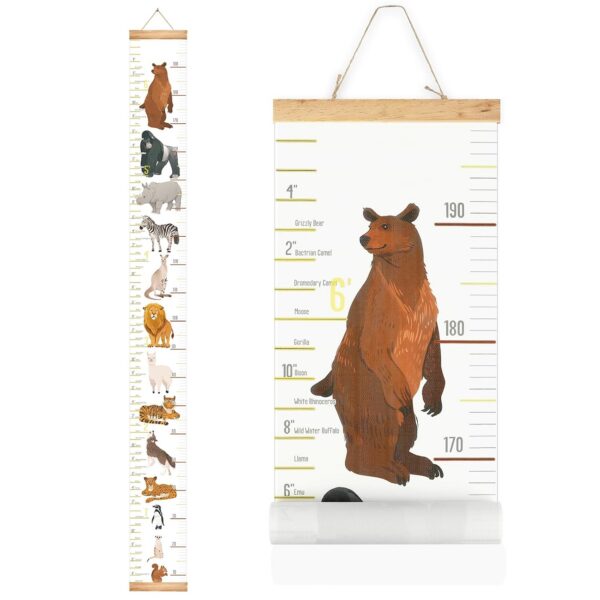
MIBOTE Growth Height Chart for Kids, Removable
Is the 10th Percentile Too Low?
Not necessarily.
A child who has always followed a growth pattern around the 10th percentile may be perfectly healthy. Family height can play a big role. Children with shorter parents may naturally be shorter than many classmates.
The same idea applies to weight. A naturally small child may have a lower weight percentile and still be healthy if the child is growing steadily, eating reasonably well, developing normally, and showing normal energy for their age.
The number itself matters less than many parents think. What often gets more attention is a major change in the child's usual growth pattern. A child who has always tracked near one part of the chart and then suddenly moves across several percentile lines may need a closer look.
Is the 90th Percentile Too High?
Again, not necessarily.
A child in the 90th percentile for height may simply be taller than most children of the same age. If the child's parents are tall, that may not be surprising at all.
A higher weight percentile also does not automatically mean that a child has an unhealthy weight. Weight needs to be considered alongside height and other factors. That is one reason healthcare providers often use BMI-for-age for children ages 2 through 19 rather than looking at weight alone.
Children's bodies also change quickly. A child may gain weight before a growth spurt and then grow taller soon afterward. Looking at one measurement without looking at the overall pattern can sometimes create unnecessary worry.
Why Do Doctors Track Height and Weight Over Time?
Growth is not always smooth. Children grow in spurts, especially during infancy, early childhood, and puberty. A child may seem to grow very little for a while and then suddenly outgrow several pairs of shoes.
That is why doctors usually focus on the growth trend rather than one visit. Growth charts help show whether a child is generally following a similar pattern over time.
The CDC also stresses that growth charts are not meant to be used as the only tool for diagnosing a health problem. They are part of a larger picture that may include medical history, physical exams, nutrition, development, and other information.
In many cases, a steady pattern is reassuring. A child does not need to stay on one exact percentile line forever, but a long-term pattern can give useful information about how the child is growing.
Why Do Some Children's Percentiles Change?
A percentile can change for many normal reasons.
A child may go through a growth spurt. A child may have been sick and temporarily lost weight. A picky eating phase may affect weight for a short time. Puberty can also change a child's height and weight very quickly.
Sometimes the change is simply due to measurement differences. Measuring height at home can be tricky. Shoes, posture, time of day, and equipment can all make a small difference.
A single change is not always a reason to worry. What matters is whether the change continues and whether there are other signs that something may be affecting the child's health or growth.
Why Are Height and Weight Percentiles Different?
It is completely normal for a child to have different percentiles for height and weight.
For example, a child might be:
- 30th percentile for height
- 45th percentile for weight
Another child might be:
- 85th percentile for height
- 80th percentile for weight
There is no rule saying height and weight percentiles must match. Children's bodies have different shapes and natural growth patterns.
This is also why comparing children with siblings, classmates, or friends can be misleading. Two children can be the same age but grow at very different rates.
What About BMI Percentiles?
BMI stands for body mass index. For children and teens, BMI is calculated using height and weight, but the result is then compared with other children of the same age and sex.
This is different from adult BMI. Children are constantly growing, so a BMI number alone does not give enough information. Healthcare providers use BMI-for-age percentiles to put the number into context.
For children ages 2 through 19, the CDC uses BMI-for-age percentile ranges as one screening tool:
- Below the 5th percentile: underweight
- 5th percentile to below the 85th percentile: healthy weight
- 85th percentile to below the 95th percentile: overweight
- 95th percentile or higher: obesity
These categories are screening tools, not complete health labels. A healthcare provider may consider many other factors before deciding whether there is a health concern.
Does a Low Percentile Mean a Child Is Unhealthy?
No. A low percentile does not automatically mean poor health.
Some children are naturally small. Genetics can strongly affect a child's height and body size. A child with smaller parents may naturally grow along a lower percentile.
However, a low percentile may deserve more attention when it comes with other changes. For example, a doctor may want to investigate if a child stops gaining weight, drops significantly from a previous growth pattern, has ongoing stomach problems, has very low energy, or shows delayed development.
The same principle applies to children at higher percentiles. A higher number alone does not provide enough information to judge a child's health.
Does a High Percentile Mean a Child Will Be Tall?
Not always.
A child who is very tall for their age may continue to be tall, but future adult height depends on many factors. Genetics is especially important. Growth during puberty can also vary widely from one child to another.
Growth charts are useful for tracking what is happening now. They are not crystal balls. They cannot tell parents exactly how tall a child will be as an adult.
Should Parents Measure Height and Weight at Home?
Parents can track growth at home, but there is no need to measure children every week. Frequent measuring can sometimes cause more worry than useful information.
If measurements are taken at home, try to keep the process consistent. Use the same scale when possible. Measure height without shoes. Keep the child's posture straight and use a flat surface.
It is also important to remember that home measurements may not be as accurate as measurements taken during a medical visit. If a number seems unusual, repeating the measurement may be more helpful than immediately assuming something is wrong.
Which Growth Charts Are Used for Kids?
In the United States, the CDC recommends different growth charts for different ages. WHO growth standards are generally used for children younger than age 2, while CDC growth charts are generally used for children ages 2 and older.
Growth charts are also separated by sex because boys and girls tend to have different growth patterns.
Common charts include:
- Length or height for age
- Weight for age
- Weight for length or height
- BMI for age
- Head circumference for younger children
Healthcare providers choose the chart that best fits the child's age and situation.
When Should Parents Talk to a Doctor About Growth?
Parents do not need to worry about every change in a percentile. Still, it is worth talking with a healthcare provider when something seems clearly different from the child's usual pattern.
Consider asking about growth if:
- A child has stopped gaining weight for a long time.
- A child suddenly drops or rises across several percentile lines.
- Growth seems much slower than expected.
- A child has ongoing diarrhea, vomiting, or poor appetite.
- A child seems unusually tired or weak.
- There are concerns about delayed puberty or development.
- A child's growth is very different from what has been expected based on family patterns.
A growth chart can raise a question, but it cannot answer every question by itself. Sometimes the change is normal. Sometimes the doctor may want to take more measurements or look at other parts of the child's health.
The Most Important Thing About Growth Percentiles
Growth percentiles can be helpful, but they are easy to overthink.
A child is not “better” at the 90th percentile than at the 20th percentile. The 50th percentile is not the gold standard. And a single measurement should rarely cause panic.
What matters most is the overall picture. Is the child growing over time? Are they developing as expected? Do they have enough energy to play and take part in daily life? Are there major changes that seem unusual?
Those questions usually matter more than chasing one number on a chart.
Children are not supposed to grow in identical ways. Some shoot up quickly. Some grow slowly and steadily. Some are built small, while others are naturally bigger. Growth charts are there to help spot patterns—not to turn childhood into a competition.
FAQ
What does the 50th percentile mean for a child?
The 50th percentile means a child's measurement is around the middle of the reference group for children of the same age and sex. It does not mean the child is healthier than children at other percentiles.
Is the 25th percentile normal for a child?
Yes. A child at the 25th percentile can be completely healthy. The child's overall growth pattern and health are usually more important than the percentile number alone.
Should my child's height and weight percentiles match?
No. It is normal for height and weight percentiles to be different. A child's body does not need to follow the same percentile for every measurement.
Is it bad if my child's percentile changes?
Not always. Children can move between percentiles during normal growth. A major or continuing change may be worth discussing with a healthcare provider, especially if other symptoms are present.
What percentile should my child be?
There is no single “best” percentile. Healthy children can grow at many different percentiles. The goal is not to reach the 50th percentile but to follow a healthy growth pattern.