A child has a seizure. The family goes through tests, and then the doctor mentions a term that sounds frightening: cortical dysplasia.
It is understandable to feel worried. The name sounds complicated, and parents may immediately wonder, “Is this a brain tumor? Will it affect my child’s learning? Does my child need brain surgery?”
Cortical dysplasia is not a brain tumor. It is a problem with how certain brain cells formed and arranged themselves while the brain was developing, usually before birth. When the abnormal area is limited to one part of the brain, doctors often call it focal cortical dysplasia (FCD). The most common problem linked with FCD is seizures, especially epilepsy.
The good news is that a diagnosis does not automatically mean a child will have severe problems. The effects can be very different from one child to another. The location and size of the abnormal area, the type of seizures, and how well the seizures respond to treatment all matter.
What Is Cortical Dysplasia?
The brain has an outer layer called the cerebral cortex. It plays a major role in movement, speech, memory, thinking, learning, and many other functions.
During pregnancy, brain cells move, grow, and organize themselves into carefully arranged layers. In cortical dysplasia, some of these cells do not develop or organize in the usual way. Think of it a little like building a large house. The rooms are there, but part of the wiring or layout was arranged differently during construction.
This difference may be very small. Sometimes it involves only a tiny area of the brain. In other children, the abnormal area can be larger or involve more than one brain region. FCD is considered a type of malformation of cortical development. In many cases, doctors cannot identify exactly why it happened. Genetic changes may play a role in some children.
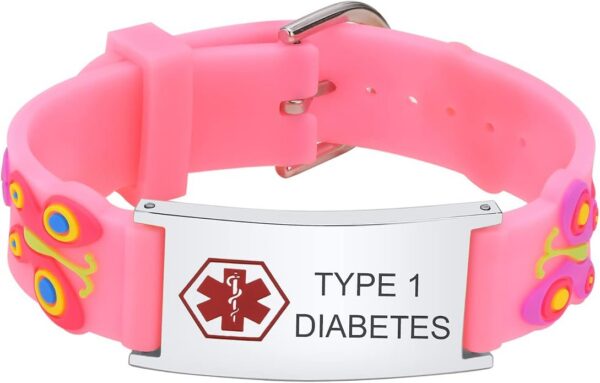
Hisatan Kids Personalized Medical ID Bracelet
Why Does Cortical Dysplasia Cause Seizures?
This is one of the most important things for parents to understand.
Brain cells normally communicate with each other in a highly organized way. An area of cortical dysplasia may have abnormal cells and connections. This can make that area more likely to produce unusual bursts of electrical activity.
That abnormal electrical activity can cause a seizure.
Seizures caused by FCD are often focal seizures, meaning they begin in a particular area of the brain. What a seizure looks like depends partly on where that area is located. A child may suddenly stare, make repeated movements, jerk one arm or one side of the body, become confused, or briefly seem unable to respond. Some focal seizures can spread and become generalized tonic-clonic seizures.
For babies, seizures may look quite different. Some infants with cortical dysplasia may have infantile spasms, which can involve brief, repeated movements of the arms, legs, or body. Any unusual repeated movement in a baby deserves medical attention, especially if it happens in clusters.
Does Every Child With Cortical Dysplasia Have Seizures?
No.
This is an important point because parents sometimes hear “cortical dysplasia” and immediately assume that seizures will always be a lifelong problem.
Seizures are the most common symptom, but children can be affected differently. Some children may have seizures that are easy to control. Others may have seizures that continue despite medication. In some cases, cortical dysplasia may be found during an investigation for another reason.
The location of the abnormal area also matters. If it involves a part of the brain responsible for movement, language, vision, or another important function, a child may have symptoms related to that area. Some children may have weakness on one side of the body, language difficulties, or learning and attention problems.
So, there is no single “cortical dysplasia child.” Two children can have the same diagnosis but very different experiences.
What Are the Signs of Cortical Dysplasia in Children?
For many children, seizures are the first major clue.
Parents may notice things such as:
- Sudden staring or becoming unresponsive
- Repeated twitching or jerking
- One arm, leg, or side of the face moving strangely
- Sudden stiffening of the body
- Repeated unusual movements
- Episodes of confusion
- Sudden falls or loss of awareness
- Seizures that happen during sleep
- Repeated spasms in a baby
Sometimes the signs are subtle. A child may simply seem to “zone out” for a few seconds. Parents may initially think the child is daydreaming or not paying attention.
That is one reason keeping a record of unusual episodes can be so useful. If it is safe to do so, a short video can give the doctor valuable information about what happened. Details such as how long the episode lasted, what the child was doing beforehand, which part of the body moved, and how the child behaved afterward can also help.
How Is Cortical Dysplasia Diagnosed?
Doctors usually need more than one piece of information to understand what is happening.
An EEG, or electroencephalogram, records electrical activity in the brain. It can help doctors identify abnormal electrical patterns and determine where seizures may be starting.
An MRI creates detailed pictures of the brain. It can sometimes show the area of cortical dysplasia. However, this is not always straightforward. Some forms of FCD can be very subtle and may not be obvious on a standard MRI.
When doctors are trying to locate the exact area responsible for difficult-to-control seizures, additional tests may sometimes be considered. Depending on the child, these can include PET, SPECT, MEG, functional MRI, or specialized EEG monitoring. Pediatric epilepsy centers may use several tests together rather than relying on one scan alone.
This is also why a “normal MRI” does not necessarily mean that cortical dysplasia has been completely ruled out. Some small abnormalities are simply difficult to see.
What Are the Different Types?
Doctors commonly describe focal cortical dysplasia as Type I, Type II, or Type III.
The categories are based on what the abnormal brain tissue looks like and whether another brain abnormality is present.
Type I involves abnormal organization of brain cells. It can be difficult to see clearly on MRI.
Type II includes abnormal-looking brain cells as well as abnormal organization. It is often easier to identify on MRI and commonly presents earlier in childhood.
Type III refers to cortical dysplasia that occurs together with another brain abnormality, such as a tumor, hippocampal abnormality, stroke-related change, or another structural problem.
Parents do not need to memorize these categories. What matters more is understanding what the child's neurologist has found, where the abnormal area is, and how it relates to the child's seizures.
How Is Cortical Dysplasia Treated?
Treatment depends heavily on the child's symptoms.
If seizures are present, anti-seizure medication is often the first treatment. Some children respond very well to medication and can have good seizure control.
But FCD is also an important cause of drug-resistant epilepsy. Some children continue having seizures even after trying appropriate medicines. When that happens, doctors may recommend a more detailed evaluation at a specialized epilepsy center.
Other options may include dietary therapy, such as a medically supervised ketogenic diet, or seizure-control devices in selected cases. These treatments are not right for every child, so they should be discussed with the child's medical team rather than started at home.
Does Cortical Dysplasia Always Require Brain Surgery?
No.
The word “surgery” can be terrifying for parents, but having cortical dysplasia does not automatically mean a child needs an operation.
Surgery may be considered when seizures are difficult to control with medication and doctors can identify a brain area that is responsible for the seizures and can be treated safely. The goal may be to remove, disconnect, or destroy the seizure-producing area while protecting important brain functions. Depending on the situation, procedures can include focal resection or less invasive approaches such as laser ablation.
The decision is complicated because the abnormal area may be close to brain regions that control speech, movement, vision, or other important abilities. Doctors therefore look at much more than the MRI picture before recommending surgery.
A pediatric epilepsy team may combine EEG, MRI, PET, SPECT, MEG, neuropsychological testing, and other information to work out where seizures begin and whether treatment can be done safely.
Can Children With Cortical Dysplasia Live Normal Lives?
Many children with cortical dysplasia can participate in school, family life, play, and activities, although their needs can vary widely.
The biggest issue is often seizure control. Frequent seizures can interfere with sleep, school attendance, learning, attention, and everyday activities. Children who have ongoing seizures may also need extra support at school.
But the diagnosis itself does not tell the whole story.
A child with a small area of FCD and well-controlled seizures may have very different needs from a child with widespread cortical abnormalities and frequent seizures. Early-onset and more widespread dysplasia have been associated with poorer cognitive outcomes in some children with difficult-to-control epilepsy, which is one reason ongoing developmental and learning support matters.
If a child is struggling with reading, speech, movement, memory, attention, or schoolwork, it is worth discussing those changes with the medical team. Support should not wait until a child is seriously falling behind.
What Should Parents Do After a Diagnosis?
A diagnosis can leave parents with a long list of questions. That is normal.
Rather than trying to understand every medical term at once, it can help to focus on a few practical questions:
- Where is the cortical dysplasia located?
- What type of FCD does the child have?
- Are the seizures coming from that area?
- What does the EEG show?
- Can the abnormal area be clearly seen on MRI?
- Are the seizures controlled with medication?
- Does the child need developmental or learning support?
- Should the child be evaluated at a pediatric epilepsy center?
- What should the family do if another seizure occurs?
- When should emergency care be sought?
It is also worth keeping a simple seizure diary. Record the date, time, possible trigger, what happened during the episode, how long it lasted, and how the child acted afterward. This can make follow-up visits much more useful.
And one practical point often gets overlooked: do not let the diagnosis become the child's entire identity. A child is still a child. They need school, play, friendships, exercise, hobbies, family time, and ordinary moments that have nothing to do with epilepsy.
When Should a Child With Seizures Get Emergency Help?
Parents should have a clear seizure safety plan from the child's healthcare team.
Emergency medical help is especially important when a seizure lasts more than five minutes, when seizures happen repeatedly without the child recovering between them, when the child has trouble breathing, or when a serious injury occurs.
During a seizure, do not put anything in the child's mouth and do not try to hold the child down. Keep dangerous objects away, protect the head if possible, and place the child on their side when it is safe to do so.
The exact emergency plan may be different for children who have an established epilepsy diagnosis, especially if they have been prescribed rescue medicine. The family should follow the child's medical instructions.
Frequently Asked Questions
Is cortical dysplasia a brain tumor?
No. Cortical dysplasia is a developmental abnormality involving the formation and organization of brain cells. It is different from a brain tumor.
What causes cortical dysplasia in children?
In many children, the exact cause is unknown. Genetic changes may contribute to some cases, and researchers are still studying how these changes affect brain development.
Can cortical dysplasia cause epilepsy?
Yes. Seizures are the most common symptom of focal cortical dysplasia, and FCD is an important structural cause of epilepsy.
Can a child have cortical dysplasia without seizures?
Yes. Seizures are common, but symptoms vary depending on the location and extent of the abnormal brain tissue. A healthcare professional needs to interpret the MRI and the child's symptoms together.
Can cortical dysplasia be seen on an MRI?
Often, yes, especially some forms such as Type II. But small areas can be difficult to detect, and some children may have a normal-looking standard MRI despite having FCD. Specialized imaging and other tests may sometimes help.