Why brushing time matters more than most people think
Brushing teeth looks simple from the outside. Just a toothbrush, some toothpaste, and a quick scrub. But timing changes everything.
If kids brush too fast, plaque stays behind. If they rush, the back teeth often get ignored. If they stop too early, cleaning is incomplete even if it looks fine at first glance.
That is why brushing time is not just a detail. It is part of the whole habit. And for kids, learning the right timing is just as important as learning how to brush.
In many homes, this becomes a daily question. How long is enough? Too long feels boring. Too short feels useless. The balance sits right in the middle.
So, how long should kids brush their teeth?
The general recommendation is simple: about 2 minutes, twice a day.
This is the standard guidance from dental professionals around the world, including the American Dental Association. It applies to both kids and adults, but children especially need structure because they do not naturally track time well.
Two minutes might sound short to adults. But for a child, it can feel surprisingly long. That is why most kids do not naturally reach it unless there is help.
Without guidance, many children brush for 20 to 40 seconds and stop. They feel like they are done, but the cleaning is incomplete.
So the goal is not just brushing. It is brushing long enough.
Why 2 minutes is the “magic number”
There is nothing random about the 2 minute rule.
It is based on how long it takes to clean all areas of the mouth properly. Teeth have different surfaces, front, back, chewing areas, and spaces between.
If brushing is too short, some areas are simply missed. That is when plaque builds up over time.
Children’s teeth are especially vulnerable because enamel is still developing. That makes consistent cleaning even more important.
The Centers for Disease Control and Prevention notes that regular brushing helps prevent cavities, which are one of the most common chronic conditions in children.
So yes, timing matters more than it seems.
Why kids struggle with brushing for 2 minutes
Here is the honest part. Most kids do not naturally enjoy brushing for two full minutes.
There are a few simple reasons for that.
First, time feels different for children. Two minutes feels longer than it does for adults. Especially when they are tired or ready for play.
Second, brushing is repetitive. It is not exciting compared to toys, screens, or stories.
Third, younger children often lose focus quickly. They start brushing well, then slow down or stop halfway.
So when kids say “I’m done,” it is not always laziness. It is usually just attention shifting.
What happens if kids brush for less than 2 minutes?
Short brushing does remove some food particles. So it is not useless.
But it is incomplete.
Plaque tends to build up in hidden areas, especially along the gum line and back molars. These are the places kids often miss when they rush.
Over time, this can increase the risk of cavities.
Dental health experts, including those referenced by World Health Organization, emphasize that consistent and proper oral hygiene is key for long term health, not just quick cleaning.
So brushing for less time occasionally is fine. But as a daily habit, it is not enough.
How to help kids actually reach 2 minutes
This is where things get practical.
Most parents find that kids do not respond well to “brush longer.” It feels like a command, not a guide.
Instead, structure helps more than instruction.
1. Use music or songs
A simple 2 minute song works surprisingly well. Kids focus on the music instead of the clock.
2. Use a visual timer
Sand timers or countdown apps help kids “see” time passing.
3. Break it into sections
Tell kids to brush each area of the mouth slowly. Front, left, right, top, bottom.
4. Brush together
When kids see adults brushing for the full time, they naturally follow.
These small tools make the 2 minute rule feel less like pressure and more like a routine.
Is brushing longer than 2 minutes better?
Sometimes kids ask this. Or parents wonder if more is always better.
The answer is no, not necessarily.
Brushing too hard or too long can actually irritate gums, especially if pressure is heavy. The goal is not duration alone, but quality.
Two minutes of proper brushing is enough for most children when done correctly.
It is more about being consistent than going beyond the recommended time.
Does age change brushing time?
Not really. The 2 minute guideline stays the same for most ages.
But how kids reach that time changes.
- Younger kids (2–4 years): need full assistance
- Preschool (4–6 years): guided brushing with help
- School age (6+): can try independently but still need reminders
Even older children may rush if not reminded.
So the time stays the same, but the support slowly decreases.
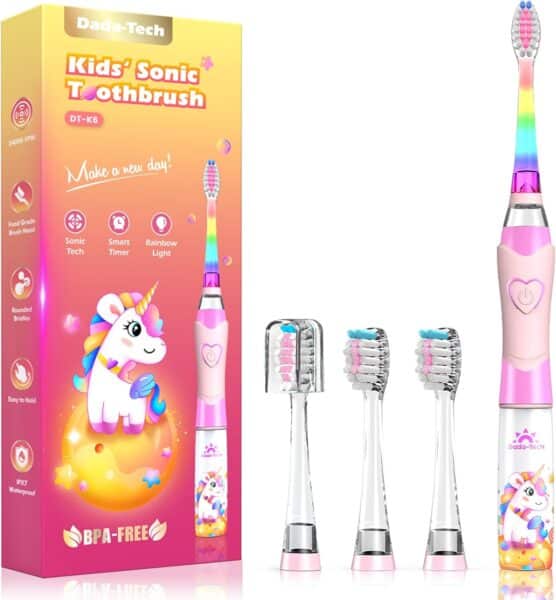
Kids Electric Toothbrush Toddler Toothbrush Age 2-4-8-12 Electric Toothbrush Kids with Timer Rainbow LED Light Up Vibrating Toothbrush Battery Operated
What makes brushing feel faster for kids
Sometimes the issue is not time itself. It is perception.
When kids are engaged, two minutes can feel short. When they are bored, it feels long.
That is why making brushing slightly interactive helps.
Simple things like brushing together, using fun toothbrush designs, or turning it into a “challenge” can shift how time feels.
It does not need to be complicated. Even small changes affect how kids experience brushing.
What if a child refuses to brush for 2 minutes?
This is more common than most people think.
In that case, forcing the full time immediately often backfires. It can turn brushing into a struggle.
A better approach is gradual building.
Start with 30 seconds. Then increase slowly over days or weeks. The goal is to build tolerance, not pressure.
Consistency matters more than perfection.
Over time, most children naturally reach the full 2 minutes once the habit becomes familiar.
Why consistency matters more than exact timing
Even though 2 minutes is the target, what really matters is daily consistency.
A child who brushes 90 seconds every day is still building a strong habit. A child who brushes 2 minutes but only sometimes is less protected.
This is why dental professionals focus on routine as much as duration.
The habit itself becomes the foundation of oral health.
Simple signs a child is brushing long enough
Instead of guessing, there are some simple signs:
- All tooth surfaces are covered
- No rushing or skipping areas
- Brushing feels steady, not chaotic
- The full mouth is cleaned, not just front teeth
If these are present, timing is usually close to correct.
FAQ
1. How long should kids brush their teeth each time?
Kids should brush for about 2 minutes, twice a day, according to dental guidelines.
2. What happens if kids only brush for 1 minute?
One minute helps but is often not enough to clean all areas properly, especially back teeth.
3. How can I make my child brush for 2 minutes?
Use songs, timers, or brush together as a family to make timing easier.
4. Do toddlers need to brush for 2 minutes?
Toddlers need assistance, but parents should aim for around 2 minutes of cleaning overall.
5. Is brushing longer than 2 minutes harmful?
Not usually, but too much pressure or rough brushing can irritate gums.