Children do not always know when they have trouble seeing. A child may think that everyone sees the world the same way they do. This is one reason vision problems can be easy to miss, especially in younger children.
Sometimes the signs are obvious. A child may squint at the TV or complain that the classroom board looks blurry. Other signs are much quieter. A child may avoid reading, lose their place on a page, rub their eyes often, or move closer and closer to the screen.
Not every one of these behaviors means a child has an eye problem. Tiredness, allergies, headaches, or simple habits can cause some of the same signs. Still, repeated changes are worth noticing. Early vision screening and treatment can be important because some childhood eye problems are easier to treat when they are found early.
1. Your Child Squints Often
Squinting is one of the most common signs that a child may be having trouble seeing clearly. Squinting can temporarily change how light enters the eye, making an image appear sharper for some people.
A child may squint when looking at the TV, reading signs, watching a teacher, or trying to see something far away. Nearsighted children, for example, may have trouble seeing distant objects clearly and may squint to make them easier to see.
Occasional squinting does not always mean there is a vision problem. But if it happens often, especially during the same activities, it is worth mentioning to a pediatrician or eye care professional.
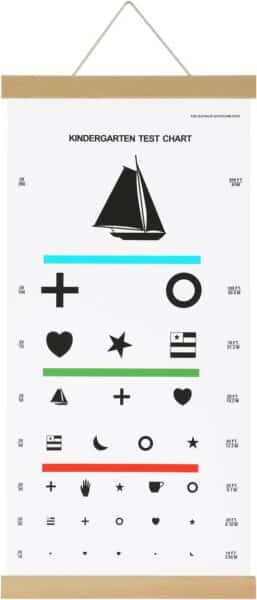
Pediatric Eye Chart for Kindergarten Child, Eye Test Chart for Kids
2. Your Child Holds Books or Screens Very Close
Many young children like to get close to books, tablets, or toys. That alone is not always a problem. But consistently holding objects unusually close to the face can be a sign that a child is trying to see details more clearly.
Older children may also move closer to the TV or sit unusually close to a computer screen. Some children do this because of habit, but repeated close viewing can be worth checking.
It is especially important to pay attention if the child also squints, complains of blurry vision, or struggles to see things across the room.
3. Your Child Cannot See the Board at School
A child who cannot clearly see the classroom board may not immediately say, “I think I need glasses.” Instead, the problem may show up in other ways.
For example, a child may:
- Ask to sit closer to the front.
- Copy notes incorrectly.
- Have trouble reading information on the board.
- Lose interest during visual classroom activities.
- Say that things far away look blurry.
Nearsightedness, also called myopia, is one possible cause of blurry distance vision. Children with myopia may have trouble seeing the board at school while still being able to see nearby objects clearly.
Sometimes a teacher notices the problem before parents do. A child who suddenly has trouble following visual work in class may need a vision check.
4. Your Child Complains of Blurry or Double Vision
Children who are old enough to describe what they see may say that things look blurry, fuzzy, doubled, or strange. These complaints should not be ignored, especially when they happen repeatedly.
Blurry vision may happen when a child looks far away, reads up close, or changes focus from near to far. Long periods of close screen use can also temporarily cause blurry vision and eye fatigue in some children.
Double vision deserves prompt medical attention, particularly if it is new or sudden. It can have several possible causes, so parents should contact a healthcare professional rather than assuming it is simply eye strain.
5. Your Child Gets Frequent Headaches
Headaches are common in children, and many things can cause them. Vision problems are only one possible reason. Still, repeated headaches that happen during reading, schoolwork, or other visual tasks are worth discussing with a healthcare professional.
A child may not connect the headache with their eyes. They might simply say their head hurts after school or after doing homework.
Headaches that are frequent, getting worse, or happening with other symptoms such as vision changes, vomiting, confusion, eye pain, or unusual weakness should be discussed with a doctor.
6. Your Child Rubs Their Eyes Often
Children rub their eyes for many reasons. They may be sleepy, tired, or dealing with allergies. But frequent eye rubbing can also happen when the eyes feel uncomfortable or strained.
Pay attention to the bigger picture. Is your child rubbing their eyes mostly after reading? After using a screen? During schoolwork? Do they also complain of blurry vision or headaches?
A single behavior rarely tells the whole story. Several repeated signs together can provide a better clue that an eye exam may be useful.
7. Your Child Closes or Covers One Eye
Some children close one eye when reading, watching TV, or looking at something carefully. They may do this to make an image clearer or more comfortable.
Parents may also notice that a child covers one eye in bright sunlight or tilts their head when focusing on something. These behaviors can sometimes be seen with vision problems such as amblyopia, commonly called lazy eye, or other eye alignment or focusing issues.
A child who repeatedly closes or covers one eye should have this behavior checked rather than being told it is just a funny habit.
8. Your Child Tilts Their Head to See
Children sometimes tilt their heads while playing or listening. But a repeated head tilt during reading, watching TV, or looking at objects can be a sign that the child is trying to see more comfortably.
A child may also turn their face to one side or consistently look from a certain angle. These behaviors can have different causes, including eye alignment or vision problems.
Because persistent head tilting can also be related to other health issues, it is a good idea to mention it to the child's doctor.
9. Your Child's Eyes Do Not Seem to Work Together
Parents may notice that one eye sometimes turns inward, outward, upward, or downward. This is known as eye misalignment or strabismus.
Newborn babies can sometimes appear to have wandering or crossed eyes. However, the American Academy of Pediatrics notes that regular eye crossing or drifting after about 4 months of age should be discussed with a doctor.
Older children can also develop eye alignment problems. If one eye repeatedly looks in a different direction, do not wait for the child to “grow out of it.” Early evaluation can be important.
10. Your Child Has Trouble Reading
Vision problems can sometimes affect how comfortable reading feels, although reading difficulties can also have many other causes.
A child may:
- Lose their place often.
- Skip lines or words.
- Move very close to the book.
- Complain that words look blurry.
- Avoid reading.
- Need frequent breaks.
- Say their eyes hurt or feel tired.
It is important not to assume that every reading problem is caused by poor eyesight. Learning differences, language difficulties, attention problems, and other factors can also play a role. Still, checking a child's vision is often a sensible step when reading becomes unusually difficult or uncomfortable.
11. Your Child Seems Clumsy or Has Trouble Judging Distance
Children are naturally developing coordination, so occasional bumps and falls are part of childhood. However, a child who regularly has trouble judging steps, catching objects, reaching for toys, or navigating familiar spaces may need a closer look.
Some vision problems can affect depth perception, which helps the brain judge how near or far objects are. Children with amblyopia, for example, may have poor depth perception.
Vision is only one possible explanation for clumsiness, but it should not be overlooked if other warning signs are also present.
12. Your Child Avoids Activities That Need Clear Vision
A child may avoid reading, drawing, puzzles, ball games, or other activities for many reasons. But sometimes the real problem is that the activity is visually uncomfortable.
A child may say they are bored with reading when the words actually look blurry. They may avoid catching a ball because judging distance is difficult. Younger children may simply become frustrated without being able to explain why.
This is why watching behavior can be useful. A child may not say, “My vision is blurry,” but their daily habits may quietly suggest that something is not right.
13. Your Child Is Very Sensitive to Light
Some children are more sensitive to bright light than others. However, eyes that regularly seem overly sensitive to light should be mentioned to a healthcare professional.
The American Academy of Pediatrics lists excessive sensitivity to light as one possible warning sign of an eye problem.
A child who frequently covers their eyes, complains that normal indoor light hurts, or cannot comfortably tolerate bright environments may need an evaluation.
14. You Notice Changes in the Appearance of the Eyes
Sometimes the most important signs are physical changes rather than complaints about vision.
Parents should pay attention to things such as:
- Eyes that appear crossed or misaligned.
- A white or grayish-white pupil.
- Rapid fluttering eye movements.
- Drooping eyelids.
- Redness that does not go away.
- Ongoing watery eyes.
- Pus or crust around the eye.
The American Academy of Pediatrics specifically lists these as signs that should be discussed with a child's doctor.
A white appearance in the pupil is especially important to have checked promptly.
Why Vision Problems Can Be Hard to Notice
Children are very good at adapting. A child with poor vision in one eye may rely heavily on the other eye and never complain. Some children simply assume that what they see is normal.
This is one reason symptoms alone are not enough. The AAP notes that some childhood eye problems may have no obvious warning signs and may only be found through vision screening.
That is also why a child should still have recommended vision screenings even if they seem to see perfectly well.
When Should Children Have Their Vision Checked?
Vision screening begins early. The eyes are checked starting in infancy, and screening continues through childhood. The type of screening changes as children get older and are better able to cooperate with eye tests.
According to the American Academy of Pediatrics, formal vision screening may begin with special instrument-based tools in younger children, while visual acuity testing can be used in cooperative preschoolers and older children.
The American Academy of Ophthalmology also supports vision screening throughout childhood, including preschool and school years. Children who do not pass a screening should receive follow-up evaluation.
When Should You Call a Doctor?
It is a good idea to contact your child's doctor if you notice repeated signs of vision difficulty. This may include frequent squinting, blurry vision, eye misalignment, regular headaches during visual activities, or difficulty seeing at school.
Some symptoms deserve faster attention. Contact a healthcare professional promptly if your child has sudden vision changes, new double vision, severe eye pain, a white pupil, a serious eye injury, or significant redness and swelling.
A vision screening or eye exam does not automatically mean a child will need glasses. Sometimes the result is reassuring. Other times, early treatment can prevent a problem from affecting a child's daily life, schoolwork, or visual development.
How Parents Can Help Protect Children's Vision
Good eye habits are useful, but they cannot replace regular screenings. Children should also be encouraged to speak up when something looks blurry or uncomfortable.
Simple habits include:
- Taking regular breaks from long periods of close-up screen use.
- Spending time outdoors.
- Wearing prescribed glasses when needed.
- Using proper lighting for reading and homework.
- Wearing protective eyewear for activities with a risk of eye injury.
- Keeping up with recommended well-child and vision screenings.
Long periods of screen use without breaks can cause eye fatigue, temporary blurry vision, headaches, and dry or irritated eyes.
The goal is not to make children afraid of screens or constantly watch every eye movement. It is simply to notice patterns. When something keeps happening, a professional check can provide answers.
FAQ:
What are the first signs of vision problems in children?
Common signs include squinting, sitting very close to screens, holding books close, frequent eye rubbing, headaches, blurry vision, and difficulty seeing the classroom board.
How can I tell if my child needs glasses?
A child may need an eye exam if they often squint, complain that things look blurry, move close to the TV, have trouble seeing at school, or regularly experience eye strain. Only a qualified eye care professional can determine whether glasses are needed.
Can a child have poor vision without knowing it?
Yes. Many children do not realize that their vision is different from normal. Some eye problems also have few or no obvious symptoms, which is why regular vision screening is important.
Does sitting close to the TV mean my child has bad eyesight?
Not always. Some children simply prefer sitting close to the TV. However, if the behavior happens often and comes with squinting or complaints of blurry distance vision, an eye check may be helpful.
Are frequent headaches a sign of vision problems?
They can be, but headaches have many possible causes. Repeated headaches, especially during reading or schoolwork, should be discussed with a healthcare professional.