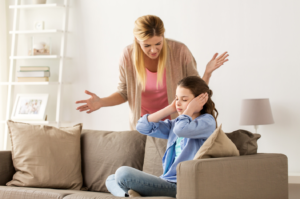
Many parents hope their children will become self-disciplined.
They want their kids to:
- finish homework without reminders
- manage their time
- control emotions
- make good choices
- keep trying when things are difficult
Because adults know how hard self-discipline can be, many parents try to teach it from an early age.
They create schedules.
They remind children again and again.
They monitor every step.
They correct mistakes quickly.
But sometimes, something surprising happens.
The more parents control, the less motivated children become.
The child may listen when a parent is watching, but when no one is there, everything changes.
Why?
Because there is a difference between being controlled and learning self-control.
A child who behaves only because someone is watching is using external control.
A child who can make choices, manage feelings, and complete tasks because they understand the value of doing so is developing self-discipline.
Real self-discipline grows from inside.
Self-Discipline Is Not the Same as Obedience
Many people confuse a well-behaved child with a self-disciplined child.
A child who always follows instructions may look very responsible.
But parents need to ask:
“Does my child understand why they are doing this?”
or
“Are they only doing it because I am forcing them?”
For example:
A child finishes homework because a parent sits next to them for two hours every night.
This child may complete assignments.
But they may not yet know how to organize their own time.
Another child may learn to plan homework, take breaks, and solve problems independently.
This child is practicing self-discipline.
The difference is not intelligence.
The difference is ownership.
Children need opportunities to experience:
“I can make decisions.”
“I can solve problems.”
“I can handle challenges.”
These experiences build confidence and internal motivation.
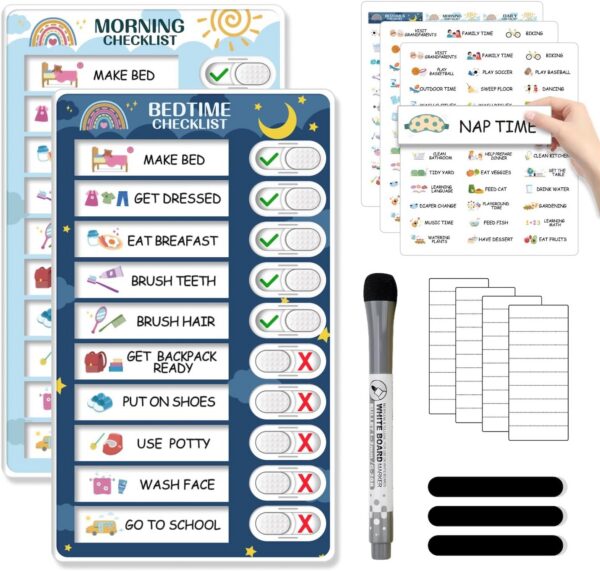
2 in 1 Bedtime/Morning Routine Chart for Kids Toddlers
Why Too Much Control Can Reduce Independence
Parents naturally want to help their children succeed.
They remind children because they care.
They correct children because they want them to improve.
They organize schedules because they want children to use time wisely.
These intentions come from love.
However, when every moment of a child’s day is planned and controlled, children may have fewer chances to practice decision-making.
A child who is always told:
- what to do
- when to do it
- how to do it
may become dependent on outside direction.
They may start thinking:
“Someone will tell me what to do.”
“I need someone to check my work.”
“I cannot decide by myself.”
This does not mean parents should completely step away.
Children still need guidance, limits, and support.
The goal is not to remove parenting.
The goal is to slowly give children more responsibility as they grow.
Why Free Time Matters for Self-Discipline
Many children today have very full schedules.
School.
Homework.
Lessons.
Sports.
Activities.
Many parents worry that free time is wasted time.
But free time is actually important for development.
When children have unstructured time, they learn to:
- choose activities
- solve boredom
- create their own games
- follow interests
- manage their time
A child who says:
“I’m bored.”
is not necessarily having a problem.
Boredom can be the beginning of creativity.
When there is nothing planned, children have a chance to ask:
“What do I want to do?”
“What interests me?”
“What can I create?”
These moments help children develop independence.
The Power of “Boredom”
Modern children often have many sources of entertainment.
Screens, videos, games, and scheduled activities can quickly fill every empty moment.
But children also need quiet moments.
Boredom gives the brain space to rest and imagine.
A child lying on the floor doing “nothing” may actually be:
- thinking
- observing
- creating stories
- processing emotions
- making plans
Adults often feel uncomfortable when children are bored.
They may quickly offer:
“Why don’t you play this?”
“Let’s find something to do.”
“Here is a screen.”
But sometimes, allowing children to sit with boredom is a valuable gift.
Children slowly learn:
“I can create my own fun.”
“I can handle uncomfortable feelings.”
“I don’t need someone else to entertain me all the time.”
These are important parts of emotional growth.
How Parents Can Help Children Build Self-Discipline
1. Give Choices Within Clear Limits
Children need freedom, but they also need structure.
Too much control can create dependence.
Too much freedom can feel confusing.
A healthy approach is:
Clear boundaries + personal choices
For example:
Instead of:
“You must read now.”
Try:
“Reading is part of our bedtime routine. Would you like to read before or after your shower?”
The parent keeps the important boundary.
The child gains some control.
2. Create Simple Daily Responsibilities
Children build confidence when they contribute.
Responsibilities should match their age.
Examples:
Young children:
- putting toys away
- choosing clothes
- helping set the table
Older children:
- managing homework time
- organizing school supplies
- planning parts of their schedule
The goal is not perfection.
The goal is:
“I am capable.”
3. Let Children Experience Natural Consequences
Parents often want to prevent every mistake.
It is understandable.
Nobody wants their child to struggle.
But small mistakes can teach powerful lessons.
For example:
A child forgets their homework.
Instead of immediately making excuses for them, parents can help them think:
“What happened?”
“What can you do differently next time?”
Children learn responsibility by experiencing manageable consequences.
4. Resist the Urge to Correct Everything
Sometimes parents teach through words.
Sometimes parents teach through patience and silence.
Not every mistake needs immediate correction.
If a child builds something differently, dresses differently, or solves a problem in their own way, parents can pause and observe.
Ask:
“Is this unsafe?”
“Is this harmful?”
“Or is this simply different from how I would do it?”
Allowing children to try things helps them develop confidence.
What Parents Should Remember
The goal of parenting is not to create a child who only behaves when adults are watching.
The goal is to raise a child who can eventually guide themselves.
Self-discipline does not grow from constant pressure.
It grows from:
- trust
- practice
- responsibility
- motivation
- healthy boundaries
Children need parents who provide direction, but also space.
They need support, but also opportunities to try.
They need rules, but also room to think.
A child who has never made choices may follow instructions well, but may struggle when facing the world alone.
A child who has learned to make thoughtful choices can gradually become confident, responsible, and self-motivated.
FAQ
How can I teach my child self-discipline?
Children develop self-discipline when they practice making choices, managing responsibilities, and learning from mistakes. Parents can help by providing clear rules while allowing age-appropriate independence.
Is strict parenting the best way to build discipline?
Strict rules may create short-term obedience, but children also need opportunities to develop internal motivation. A balance of structure and independence usually supports healthier self-control.
Why does my child only behave when I am watching?
Some children rely on external reminders because they have not yet developed internal self-management skills. With practice and guidance, children can gradually learn to manage tasks independently.
Is boredom good for children?
Yes. Boredom can encourage creativity, problem-solving, and independence. Children need some unstructured time to learn how to entertain themselves and follow their interests.
How much freedom should parents give children?
The amount depends on the child’s age and maturity. Younger children need more guidance, while older children can gradually take more responsibility for choices and routines.