Introduction
If you have children at home, you probably know this feeling.
You spend time cleaning the room. Toys are organized. Books are back on the shelf. Everything finally looks neat.
Then your child starts playing.
Soon, blocks cover the floor, crayons appear on the table, blankets become a tent, and stuffed animals become part of a new imaginary world.
Many parents look at the mess and think:
“Why can’t my child put one toy away before taking another one out?”
“Why does the house become messy so quickly?”
These feelings are completely normal. Keeping a home organized with children is not easy.
But there is something important to remember: a little mess during play is not always a bad thing.
Sometimes, a messy play area means a child is exploring, creating, and learning.
The goal is not to let children make unlimited messes. Children still need to learn responsibility and organization.
The healthy balance is:
Let children explore freely during play, then teach them to clean up afterward.
Both creativity and responsibility are important parts of growing up.
Messy Play Can Help Build Creativity
When people talk about a “smart” child, they often think about grades, memory, or problem-solving skills.
But intelligence is more than getting the right answers.
Children also need:
- imagination
- flexible thinking
- creativity
- problem-solving skills
- confidence to try new ideas
Creative play gives children a chance to practice these skills.
For adults, a cardboard box is usually just a box.
For a child, it could become:
- a spaceship
- a house
- a store
- a robot
A blanket can become a castle.
A chair can become a train.
A collection of small objects can become a treasure collection.
Children naturally look at the world differently. They are not limited by the “correct” use of an object. They ask:
“What else can this become?”
That simple question is the beginning of creativity.
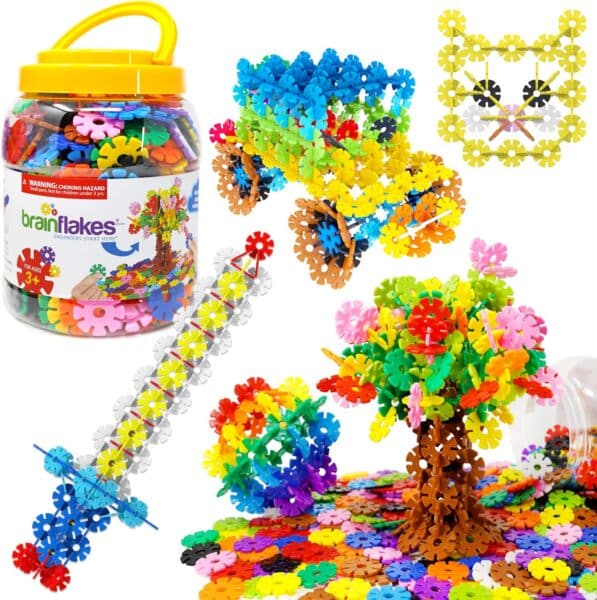
Brain Flakes 500 Piece Set, Ages 3+, Interlocking Plastic Disc Toy for Creative Building
Why Open-Ended Toys Are Important
Child development experts often talk about open-ended play.
Open-ended toys do not have only one way to use them.
Examples include:
- blocks
- cardboard boxes
- art supplies
- fabric pieces
- empty containers
- natural materials
These materials allow children to create their own ideas.
For example, a building toy with one fixed design teaches children to follow instructions.
But a pile of blocks allows children to decide:
“What should I build?”
“How can I make it stronger?”
“What happens if I change it?”
These small experiments help children practice thinking skills.
A room full of creative materials may look messy to adults, but it may be a place where children are learning.
Why Parents Should Not Clean Up Too Quickly
Many parents naturally want to keep the house clean.
They see toys on the floor and immediately put them away.
They organize the craft supplies.
They return books to the shelf.
There is nothing wrong with wanting a tidy home.
However, when children are deeply focused on play, constantly stopping them to clean may interrupt their thinking.
Imagine a child building a tower.
They are testing:
- Which blocks work best?
- How tall can it become?
- How can they fix it when it falls?
That process teaches patience and problem-solving.
Instead of cleaning everything immediately, parents can create a simple rule:
Play first. Clean up later.
Children need time to create, but they also need to learn what happens after play.
Cleaning Up Also Helps Children Grow
A common misunderstanding is that creativity and organization are opposites.
They are not.
Cleaning up after play teaches children valuable life skills.
When children organize toys, they practice:
- sorting
- planning
- decision-making
- attention
- self-control
For example:
“Where does this toy belong?”
“Should these blocks go together?”
“What should I put away first?”
These small decisions help develop executive function skills, which are important for school and everyday life.
Cleaning up is not just about making the room look better.
It is also practice for independence.
How Parents Can Create a Creative but Organized Home
A child-friendly home does not need to be perfectly clean.
It needs to support both creativity and responsibility.
Here are some simple ideas.
1. Create a Play Area
A special play area can help children know where toys and projects belong.
It can be:
- a corner of the living room
- a play mat
- a small table
The goal is not to restrict play.
It simply makes cleanup easier.
2. Reduce Too Many Toys
Sometimes children have so many toys that they cannot focus.
Too many choices can also make cleanup harder.
Try rotating toys.
Keep some available and store others away.
When old toys come back later, they often feel new again.
3. Keep Storage Simple
Children need storage systems they can actually use.
Instead of many complicated categories, try:
- one box for blocks
- one basket for cars
- one shelf for books
- one container for art supplies
Simple systems help children become independent.
4. Give Small Cleanup Tasks
“Clean your room” can feel overwhelming.
Try smaller instructions:
“Put the blocks in the box first.”
“Now put the books on the shelf.”
Small steps help children succeed.
What If Children Refuse to Clean Up?
Many children do not refuse because they are lazy.
Sometimes they:
- are not ready to stop playing
- feel attached to their creation
- do not know where to start
Parents can try three steps.
First, acknowledge feelings.
“I know you worked hard on this tower.”
Second, explain the reason.
“We need to clear the floor before dinner so everyone can walk safely.”
Third, offer choices.
“Do you want to clean the blocks or the cars first?”
Giving children some control often makes cooperation easier.
Finding the Right Balance
Children need both freedom and boundaries.
They need time to:
- imagine
- create
- experiment
- explore
They also need to learn:
- responsibility
- organization
- respect for shared spaces
A healthy routine looks like this:
Create → Play → Clean Up → Start Again
A perfect home is not the goal.
A home where children feel safe to explore and learn is much more valuable.
Sometimes, a little mess is simply a sign that a child is busy growing.
FAQ
Is a messy room bad for children?
Not always. During play, some mess is normal and can support creativity and exploration. However, children should also learn to organize and care for their belongings.
Does messy play improve creativity?
Messy and open-ended play can encourage children to think creatively because they can experiment, combine materials, and create their own solutions.
At what age should children clean up toys?
Toddlers can begin helping with simple cleanup. As children grow, they can gradually take more responsibility for organizing their toys and belongings.
How can parents encourage kids to clean up?
Make cleanup simple and predictable. Give small tasks, clean together, and praise effort rather than expecting perfection.
Should children have fewer toys?
Many children benefit from having fewer toys available at one time. Rotating toys can help children focus better and make cleanup easier.